
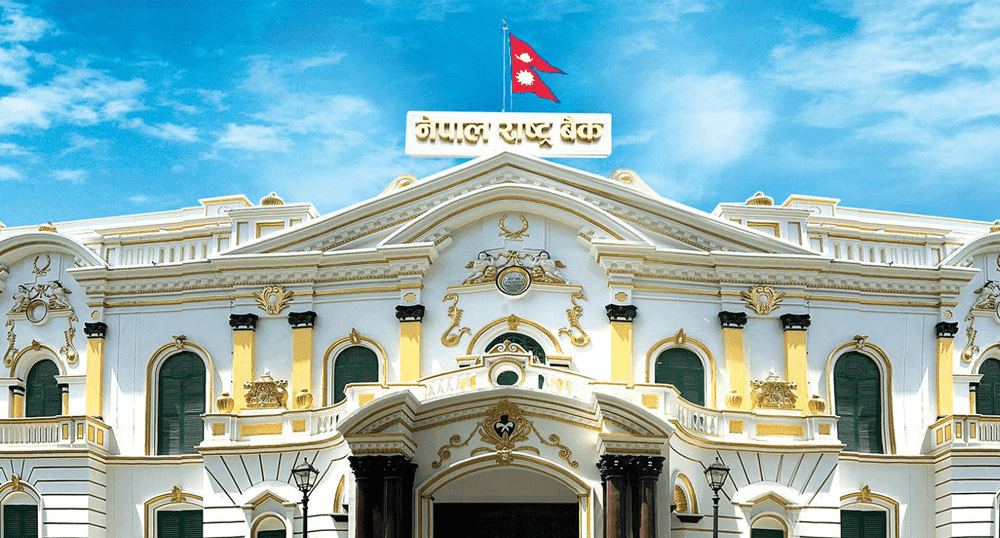
Nepal Rastra Bank (NRB) is the central bank of Nepal. It issues the Nepalese rupee, formulates monetary and foreign exchange policy, manages the country's foreign currency reserves, and licenses and supervises every bank and financial institution operating in Nepal. It is a regulator rather than a retail bank — the public deals with it for a narrow set of services such as government transactions, currency exchange matters, and complaints against banks, while day-to-day banking is done through the institutions it supervises.
History
Nepal Rastra Bank began operations on 26 April 1956 (14 Baisakh 2013 BS) under the Nepal Rastra Bank Act, 1955. Until then Nepal had no central bank, and Indian and Nepalese currency circulated side by side across much of the country.
The bank issued its first banknotes in February 1960 and completed the removal of dual currency circulation in 1964, establishing the Nepalese rupee as the country's sole legal tender. In 1974 it became a founding member of the Asian Clearing Union. The Nepal Rastra Bank Act, 2002 replaced the original legislation as part of the financial sector reform programme announced in 2000, giving the bank greater autonomy over monetary policy; it published its first formal monetary policy statement in 2002/03.
What Nepal Rastra Bank does
- Issues and manages the Nepalese rupee, including banknote printing, distribution and the withdrawal of unfit notes
- Formulates and implements monetary policy, setting the policy rate, liquidity and credit conditions for the banking system
- Licenses, regulates and supervises commercial banks, development banks, finance companies and microfinance institutions
- Manages Nepal's foreign exchange reserves and administers the foreign exchange regime, including remittance and foreign investment rules
- Operates and oversees national payment systems, including clearing, settlement and licensing of payment service providers
- Acts as banker and fiscal agent to the Government of Nepal
- Publishes economic research, banking statistics and the annual Financial Stability Report
- Runs financial literacy programmes and handles public grievances against banks and financial institutions
How it regulates Nepal's banking system
NRB classifies licensed institutions into four categories: Class A commercial banks, Class B development banks, Class C finance companies and Class D microfinance financial institutions. Each class carries its own minimum capital requirement and permitted scope of business.
The regulator issues a unified directive to licensed institutions each year covering capital adequacy, loan classification and provisioning, single-obligor limits, the credit-to-deposit ratio, interest rate spread, corporate governance and deprived-sector lending. NRB's merger and acquisition policy has driven substantial consolidation in Nepal's banking sector since 2011, reducing the number of commercial banks from more than thirty to twenty through mergers and acquisitions.
Offices
The central office sits at Baluwatar in Kathmandu. The Banking Office at Thapathali handles government revenue and payment transactions and public-facing counter services in the capital. Eight provincial offices extend supervision, currency management and government banking across the country: Biratnagar, Janakpur, Birgunj, Pokhara, Siddharthanagar, Nepalgunj, Surkhet and Dhangadhi.
Contacting the bank
General enquiries go through the information officer, and media queries through the spokesperson's office. Complaints about a licensed bank or financial institution can be filed through NRB's grievance channel once the matter has first been raised with the institution concerned. Public counters follow government office hours, Sunday to Friday.
At a glance
- Type: Central bank and financial regulator
- Established: 26 April 1956 (14 Baisakh 2013 BS)
- Governing law: Nepal Rastra Bank Act, 2002
- Central office: Baluwatar, Kathmandu (P.O. Box 73)
- Banking office: Thapathali, Kathmandu
- Provincial offices: Biratnagar, Janakpur, Birgunj, Pokhara, Siddharthanagar, Nepalgunj, Surkhet, Dhangadhi
- SWIFT code: NRBLNPKA
- Phone: +977-1-5719641 to 5719643
- Email: information@nrb.org.np
- Website: nrb.org.np