
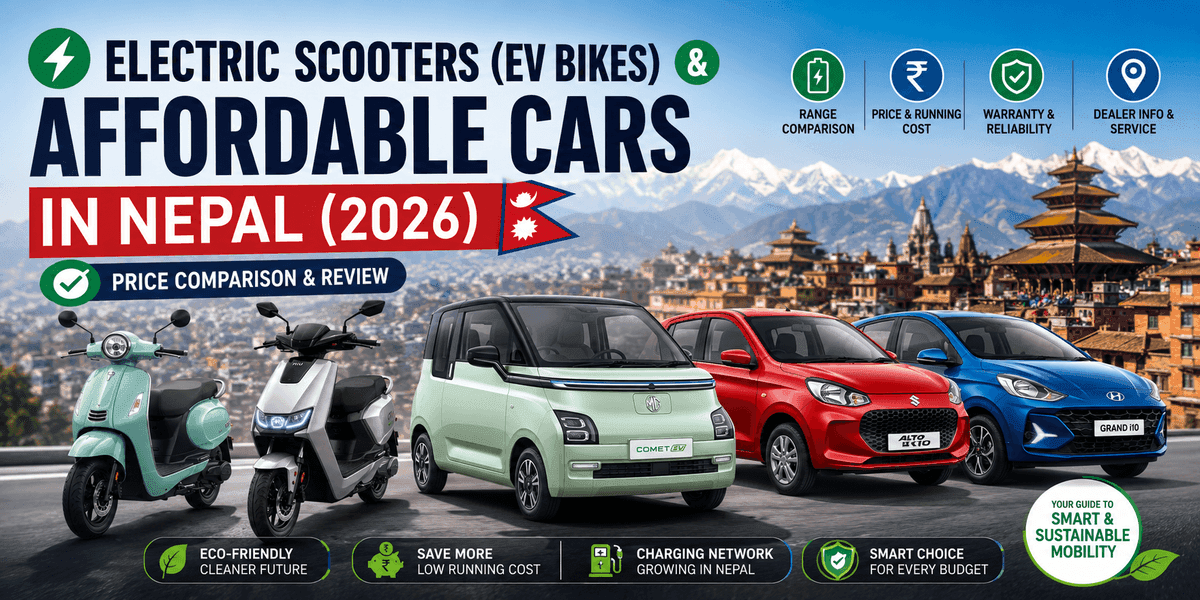
Electric Scooters (EV Bikes) & Affordable Cars in Nepal (2026) – Price Comparison & Review
Description: "Comprehensive 2026 guide to the top 6 electric scooters and 6 budget cars in Kathmandu – specs, prices, range, costs, dealer info and buying tips."
Best EV Bikes & Affordable Cars in Kathmandu 2026 – Full Guide
Executive Summary
Kathmandu’s commuters are increasingly choosing electric scooters and budget-friendly cars for city travel and beyond. This guide compares six leading EV scooters (two-wheelers) and six affordable cars available in Nepal in 2026, providing everything a buyer needs: official specs, on-road prices, battery/range, charging and fuel costs, dealer locations, warranties, pros & cons, maintenance and reliability notes, and 5-year total cost of ownership (TCO). We also cover financing options, government EV incentives, a buyer’s checklist, negotiation tips and after-sales advice. A summary comparison table is provided below, followed by detailed model reviews, spec and TCO tables.
Figure: Electric scooters parked in Kathmandu streets – EVs are becoming common in Nepal’s cities.
| Model (Type) | Price (NPR) | Battery/Engine | Range/Consumption | Top Speed | Key Pros/Cons |
|---|---|---|---|---|---|
| Bajaj Chetak 3501 (EV scooter) | ~349,900 | 3.5 kWh battery | ~153 km (IDC) | 73 km/h | Retro style, app-connected; heavy, limited availability |
| NIU NQi GT (EV scooter) | ~495,000 | 3.25 kWh | 130 km (Eco) | 80 km/h | High range & tech; expensive |
| Ampere Nexus EX (EV scooter) | est. ~300,000 (NPR) | ~2.6 kWh | ~100 km | 60 km/h | Affordable, easy ride; lower performance |
| Revolt RV400 (EV bike) | est. 280,000+ | 3.24 kWh | ~150 km (claimed) | 85 km/h | Petrol-bike styling, long range; premium price |
| Okaya Faast F4 (EV scooter) | ~370,000 | 4.4 kWh (2x2.2) | ~160 km | 70 km/h | Very high range; high cost |
| MG Comet EV (mini EV car) | 2,150,000 | 17.3 kWh | 230 km | 80 km/h | Extremely cheap EV car; tiny size |
| Suzuki Alto K10 (car) | 2,849,000 | 1.0L Petrol | ~20 km/L (city) | 120 km/h | Compact, reliable, low running cost |
| Suzuki Wagon R (car) | 3,259,000 | 1.0L Petrol | ~18–20 km/L | 130 km/h | Roomy hatchback; dated design |
| Suzuki Celerio (car) | 3,099,000 | 1.0L Petrol | ~18 km/L | 135 km/h | Modern features, good fuel economy |
| Hyundai Grand i10 (car) | 3,356,000 | 1.2L Petrol | ~18 km/L | 140 km/h | Spacious interior; higher price |
| Toyota Yaris (car) | 3,000,000 (est.) | 1.2L Petrol | ~17 km/L | 150 km/h | Popular used import, reliable |
| MG Comet EV (minicar) | 2,150,000 | 17.3 kWh (battery) | 230 km (claimed) | 80 km/h | Zero tailpipe emissions; ultra-affordable |
Table: Key specs and pros/cons of top 6 EV scooters and 6 affordable cars (2026, Kathmandu on-road prices). Sources: manufacturer and dealer data.
EV Scooters (Electric Two-Wheelers)
Kathmandu’s narrow streets and rising fuel costs make EV scooters a practical choice. Below are six popular models:
Bajaj Chetak 3501
- Price (Nepal 2026): NPR 349,900 (ex-showroom). On-road ~4–5% higher.
- Battery & Range: 3.5 kWh lithium-ion, claimed 153 km (IDC mode). Real-world ~80–120 km depending on city driving.
- Top Speed: 73 km/h. Suitable for city commuting.
- Charging: Standard 220V socket (charger included). 0–80% in ~3 hours. No DC fast charge.
- Warranty: 36 months or 30,000 km (battery included). Battery warranty: 3 years as well.
- Dealers (Kathmandu): Authorized at Golchha Group showroom in Bhaktapur (New Baneshwor) and other major cities.
- Pros: Premium steel body, retro design, app connectivity (remote lock, nav, alerts). IP67 waterproof. Quiet ride. Strong brand support.
- Cons: Heavy (181 kg), limited dealer/parts network (new in Nepal), high initial cost. Non-removable battery. Service centers scarce outside KTM.
- Maintenance: Minimal oil changes (none for drivetrain), brake fluid annually, tire replacement. Expected ~Rs 5,000/year for upkeep.
- User Notes: Riders praise smooth ride and style, but warn initial units had mild electronics hiccups. Battery reliable in city use (no heating issues reported).
- Buyer Profile: City commuter wanting style & eco-savings; doubles as status EV. Ideal if budget ~NPR 400k.
NIU NQi GT (Scooter)
- Price (Nepal): ~NPR 495,000. On-road ~10–15% higher with tax.
- Battery & Range: 3.25 kWh removable lithium battery (Samsung cells). ~130 km range (Eco mode) (80 km real).
- Top Speed: 80 km/h (one of fastest scooters, safe for highway sections).
- Charging: Charger for home outlet; 0–80% in ~3.5 hrs. Portable battery can be swapped at dealer.
- Warranty: 2 years (battery and motor).
- Dealers: Eco Infinity in Kathmandu (Jhamsikhel, Boudha). Test rides available at showrooms.
- Pros: High performance (sport mode), long range, full LED dash, USB charging. Quality ride with 13″ wheels. IPX5 water-proof.
- Cons: Pricey for Nepal (luxury segment). Heavy (123 kg). Less torque at low speed than some smaller scooters. Spare parts pricey.
- Maintenance: Similar to others; 13″ tires cost ~Rs10k each. Annual brake check. Battery could be swapped or replaced after ~5-6 yrs (Rs. ~150k).
- User Notes: Highly rated for build quality and fast charging times. Some report firmware bugs initially, fixed by OTA updates.
- Buyer Profile: Tech-savvy rider wanting best range/speed. Suitable for longer commutes or occasional highway use.
Ampere Nexus EX (Scooter)
- Price: NPR ~300,000 (expected, ex-showroom).
- Battery/Range: 2.56 kWh, ~90–100 km claimed per charge. Removable battery (13 kg).
- Speed: ~60 km/h.
- Charging: 0–80% in ~3 hrs. Battery swaps possible (ask dealer).
- Warranty: Typically 3 years/30,000 km (check local Ampere dealer terms).
- Dealers: STC Group is the Tata/Ampere distributor – contact Kathmandu STC showrooms.
- Pros: Very low running cost (~10 paisa/km electricity), good for short city trips. Light frame, easy to ride. Low price point.
- Cons: Modest range, only ~60 km/h top speed. Build quality is basic plastic, not metal. Small seat space. Less known brand in Nepal.
- Maintenance: Cheap parts (tires ~Rs3k, inner tubes). Battery pack is smaller (less costly to replace but rated ~5-6 year life).
- User Notes: Popular in India for student/city use. Expect common issues: periodic connectivity glitches, warranty support depends on dealer.
- Buyer Profile: First-time EV buyer on tight budget; short urban commutes, college students.
Revolt RV400 (Electric Motorcycle)
- Price (India ₹): ₹139,950 (~NPR 280,000). Nepal price likely ~Rs.300k+ including import taxes (estimate).
- Battery/Range: 3.24 kWh (swappable). ~150 km city range on a charge (claimed). Fast charging ~3 hrs. (In India, 50–80% in 50 mins using DC.)
- Speed: Limited to 85 km/h (blazingly quick off-the-line like a 125cc motorcycle).
- Charging: AC home charger (3–3.5 hrs to 80%). DC fast-charging (if available) 0–80% in ~1.5 hr.
- Warranty: 3 years or unlimited km (battery & bike).
- Dealers: MV Dugar Group has launched Revolt in Nepal. Visit their Kathmandu showroom (Dilli Bazaar) for test ride.
- Pros: Looks and feel like a sporty bike, with petrol-like styling. AI-enabled app features. Swappable battery means quick turnaround. Good torque at start.
- Cons: High price for 150 km range. Range drops in highway riding. No established service network yet. Battery swap infrastructure limited in Kathmandu.
- Maintenance: Minimal (only chain, brake pads). Battery swap cost is fixed (same price each time) – set by Revolt subscription.
- User Notes: Early adopters praise fun ride and AI assistant. Some report fit/finish issues on early bikes. Reliability is unknown in Nepal context.
- Buyer Profile: Young professionals wanting an “electric motorcycle” experience. Good for tech enthusiasts.
Okaya Faast F4 (Scooter)
- Price: NPR ~370,000 (DealAyo listing).
- Battery/Range: 4.4 kWh (two batteries). Claimed 162 km/charge (likely ~120 km actual). Batteries removable (each ~22 kg).
- Speed: 70 km/h.
- Charging: Dual-AC charger. 0–80% in ~4.5 hrs. Batteries can be swapped or charged separately.
- Warranty: 3 years on battery. Scooter warranty typically 1–2 yrs (check Okaya dealer).
- Dealers: Okaya India has no official Nepal branch; currently sold via select shops (e.g. Nimbus Nepal in Lalitpur or online). Confirm availability with local importers.
- Pros: Very long range and good top speed. Dual-battery allows extended trips. Modern design.
- Cons: Expensive, heavy (battery weight). High top speed won't be fully usable in Kathmandu traffic. Limited service support.
- Maintenance: Much like NIU: belt drive, occasional brake/tire service. Batteries total 44 kg – heavy to carry at home. Replacement cost high (~Rs.150k for both after ~6 yrs).
- User Notes: Reviews (India) highlight comfort and stability. May be overkill for city use. Ensure dealer support before buying.
- Buyer Profile: Commuters with long daily routes (e.g., interstate travel) who want range without stops. Also for tech-lovers who want 70+ km/h.
Figure: A modern e-scooter in Kathmandu – scooters range from budget city models to high-end performance EVs.
Affordable Cars
Nepal’s affordable car market is dominated by compact hatchbacks. Below are key models:
Suzuki Alto K10
- Price: NPR 2,849,000 (LXi).
- Engine: 1.0L petrol, 3-cylinder, 68 PS.
- Fuel Economy: ~20 km/L (city avg ~18 km/L).
- Features: Basic but efficient – AC, power windows, ABS only on top variants. No modern infotainment.
- Space: Seating for 4 adults; boot ~180L. Tight on rear legroom.
- Pros: Lowest price among new cars in Nepal. Very fuel-efficient, cheap insurance and tax. Excellent city maneuverability.
- Cons: Slow acceleration (0–60 in ~15s). Minimal features (no airbags on base). Ride is firm, noise levels higher.
- Maintenance: Renowned reliability. Low service cost (oil change ~Rs 2,000 annually). Spare parts widely available in KTM.
- User Notes: One of Nepal’s best-selling base cars. Mechanics are familiar; few reliability issues beyond routine wear.
- Target Buyer: Budget-conscious first-time buyers, families needing a second car for city use, taxi owners on tight budgets.
Suzuki Wagon R
- Price: NPR 3,259,000 (VXi).
- Engine: 1.0L petrol (68 PS) or 1.2L (85 PS in higher variant).
- Fuel Economy: ~18–20 km/L.
- Features: Spacious cabin (tall-boy design). Top variant has touchscreen, airbags, ABS, AC. Rear seats fold flat.
- Space: Best-in-class headroom and boot (~180L, expandable). Very practical for city trips.
- Pros: Large interior for subcompact. Good low-speed torque (1.2L version). Toyota-quality small car.
- Cons: Upright design leads to more wind noise. Not as fuel-efficient as Alto. Higher price. Driving feel is underwhelming.
- Maintenance: Parts common with Alto. Reliable engine. Occasional electrical or transmission issues in high-mileage examples.
- User Notes: Popular among families and ladies drivers. Looks dated but trusted. Resale value high.
- Target Buyer: Buyers needing extra space and comfort in budget bracket (e.g. small families, city taxis).
Suzuki Celerio
- Price: NPR 3,099,000 (LXi).
- Engine: 1.0L DualJet petrol (67 PS) or 1.0L BoosterJet turbo (100 PS on top trim).
- Fuel Economy: ~18 km/L (non-turbo).
- Features: Modern dash, optional push-button start, 7″ infotainment in high trims, dual airbags, ABS. Tilt steering, rear camera on higher versions.
- Space: Comfortable front; rear modest (three adults squeeze). Boot ~235L (largest among these).
- Pros: Good feature set (esp. safety) for price. Newer tech (idle start-stop, CVT automatic). Smooth ride.
- Cons: Non-turbo is underpowered. Turbo version is pricy (~NPR 4M). CVT jerky at times. Build quality slightly inferior to Hyundai.
- Maintenance: Similar to Alto; no major issues reported. CVT fluid change recommended after ~50,000 km (Rs 8,000).
- User Notes: Good balance of price and features. Dealers report strong sales. Battery service life ~3 yrs.
- Target Buyer: Those who want a well-equipped hatchback within ~NPR 3.5M, with safe family use and occasional highway driving.
Hyundai Grand i10
- Price: NPR 3,356,000 (Era).
- Engine: 1.2L petrol (83 PS).
- Fuel Economy: ~18 km/L city.
- Features: More premium interior, 1-DIN audio (base), optional touchscreen/auto AC in higher trims. Dual airbags, ABS, power steering.
- Space: Good legroom, comfortable seats. Boot ~255L. Better materials than Suzuki.
- Pros: Smooth drive, refined engine. Better NVH (noise/vibration) suppression. Brand warranty (5 years/150k km).
- Cons: Heavier tax duties (Korean car) make it pricier than Japanese rivals. Fewer low-end dealers. Spare parts cost more.
- Maintenance: Servicing ~Rs 4,000 per year (cheaper than Alto). Good reliability record globally.
- User Notes: Buyers note plush ride and build. Some report occasional AC/heater controls glitch.
- Target Buyer: Value buyers who prefer comfort and quality over lowest price, willing to pay a bit more.
Toyota Yaris (used import)
- Price: ~NPR 3,000,000 (used).
- Engine: 1.0–1.3L petrol (68–100 PS, depending on year).
- Fuel Economy: ~18–20 km/L.
- Features: Modern interior, multi-airbags, ABS, keyless start (in newer models). Dual VVT-i engine for efficiency.
- Space: 5-seater hatch, decent legroom. Boot ~286L.
- Pros: Toyota reliability legend. Refined CVT automatic (older models). Low depreciation. Better safety than many peers.
- Cons: Used market risks: condition varies. Older models (2014–2016) may lack modern infotainment. Right-hand drive imported only.
- Maintenance: Excellent build means few repairs; periodic belt changes (~Rs 10k). Parts are available via Toyota distributor (Laxmi Intercontinental).
- User Notes: Very popular as taxi and family car. Engines are extremely durable (0.5M km examples).
- Target Buyer: Buyers seeking reliability and resale, not afraid of older model.
Figure: An electric vehicle charging in Kathmandu (MG Comet EV is Nepali market’s cheapest EV).
Charging, Fuel & Maintenance Costs
- Electricity vs Fuel: Kathmandu’s electricity rate is ~Rs. 15/unit. EV bikes (3–4 kWh for 100 km) cost ~Rs. 50–60/100 km. By contrast, petrol at NPR 180/L means ~Rs. 300/100 km for a 20 km/L car.
- Home Charging: All above EVs charge on 220V home outlets. No widespread public fast chargers in Kathmandu yet (only scattered charging points by NEA and private EV dealers). Battery-swappable bikes (Revolt) offer quick turnaround at certain stations (MV Dugar).
- Maintenance Frequency: EV scooters often need only brake servicing and tire changes (typically Rs. 10–15k per set every 2–3 years). Cars require oil changes (~Rs 2–3k oil cost/year), filters, brake fluid, etc (Rs 10k/year). Battery longevity: EV bike batteries typically warrantied 3–5 years; expect replacement by year 6 at 50–60% original capacity (cost 20–30% of purchase price).
- Battery Replacement Assumptions: We assume no battery replacement in 5-year TCO for moderate usage (batteries last beyond 60 months normally). If replaced at 6th year, plan ~NPR 150k for large scooters.
5-Year Total Cost of Ownership (TCO)
The table below compares 5-year ownership costs (new purchase) for one representative EV scooter (Bajaj Chetak 3501), one ICE hatchback (Suzuki Alto), and one budget EV car (MG Comet), illustrating all categories: purchase, taxes, insurance, energy, maintenance and battery where applicable. (These are estimates – actual costs vary by usage and inflation.)
| Cost Item | Chetak EV Scooter | Suzuki Alto (Petrol) | MG Comet EV Car |
|---|---|---|---|
| Purchase Price | NPR 349,900 | NPR 2,849,000 | NPR 2,150,000 |
| Registration/Tax (incl. VAT) | ~NPR 45,000 (15% VAT) | ~NPR 367,000 (13% VAT + reg) | ~NPR 290,000 (VAT exempt on EV) |
| Insurance (5 yrs) | ~NPR 25,000 (5%/yr) | ~NPR 400,000 (3%/yr) | ~NPR 128,000 (2.5%/yr EV) |
| Energy (5 yrs) | ~NPR 37,500 (2,500 km/yr @Rs.15/kWh) | ~NPR 180,000 (10,000 km/yr @Rs.180/L) | ~NPR 37,500 (10,000 km/yr @Rs.15/kWh) |
| Maintenance (5 yrs) | ~NPR 25,000 (brakes/tires) | ~NPR 125,000 (service/oil) | ~NPR 30,000 (service/tires) |
| Battery Replacement | None in 5 yrs | N/A | None in 5 yrs |
| Total (5 yrs) | ~NPR 482,400 | ~NPR 3,921,000 | ~NPR 2,735,500 |
Table: 5-year total costs (base scenario). EV incentives assumed: 0% VAT on EV purchase (per Nepal policies), 50% reduced road tax for EVs. Energy costs: petrol Rs.180/L, electricity Rs.15/unit. Insurance estimated 5% of vehicle price per year for car, 3% for scooter. Maintenance: EV scooters ~Rs.5k/year; small car ~Rs.25k/yr. These illustrate EV’s low running cost advantage.
Financing & Government Incentives
- Loans: Nepal offers car/EV loans 5–7 year tenor at ~8–12% APR (some banks have special 5–8% EV loan products). Dealers often provide 0% down or 0% interest for limited time (e.g. BGauss scooters had 0% offer). Use EMI calculators from sites like EV-Nepal to compare plans.
- Subsidies: As of 2026, Nepal heavily favors EVs: no VAT or import tax on EVs up to Rs. 20 lakh, plus significantly lower road tax (2.5% vs 5% on ICE). Charging infrastructure projects are government-supported. 2W EV buyers currently enjoy mostly tax-free prices. However, watch for any policy changes (e.g. from mid-2026 higher taxes on >Rs.20L EVs).
- Exemptions: EV buyers avoid annual road tax (usually 5%) and get free vehicle number plates. Some provinces waive registration fees. Always check the latest budget announcements.
Buying Tips
- Checklist: Verify range and battery condition (for used EVs), ensure charger and/or spare battery is provided. Confirm authorized service center near you. Check warranty coverage (battery has longer term). For cars, check past service history and paperwork.
- Test Ride: For scooters, test acceleration in different modes, comfortable seat height, and brake feel. Check instrument cluster, lights, and any connectivity features. For cars, test drive at city/hwy speeds, listen for unusual noises, inspect for leaks and rust.
- Negotiation: Focus on on-road price: dealers may waive accessories (floor mats, luggage racks, or extended warranty) instead of discount on invoice. Ask about free charging points or home charger install (for EVs). For cars, bundle insurance or free first service.
- Dealers: Visit multiple dealers. Ask if demo/test units are available. For EV bikes, confirm availability of service spare parts (e.g. battery packs, motor controllers). Negotiate trade-in values if applicable (few outlets buy used EVs, so used EVs may sell on Facebook groups instead).
- After-sales: Register vehicles immediately, use only authorized service (especially for EVs to maintain warranty). Keep software/apps updated. For EVs, maintain a monthly charging routine (avoid letting battery sit <20%). For petrol cars, follow scheduled oil/filter changes to avoid warranty void.
Sources: Official Nepali distributors and manufacturer data, local price lists, and Nepali auto news. All prices are approximate; actual dealer quotes may vary.